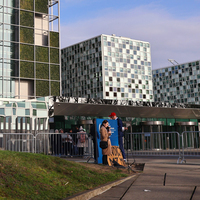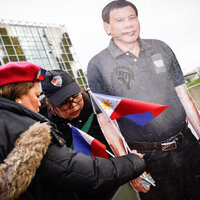



THE HAGUE, Netherlands (CN) - After four days of exchanges in a Hague courtroom, the fate of Rodrigo Duterte's drug war case now rests with judges at the International Criminal Court, who must decide whether the former Philippine president is headed for a full trial over dozens of charged killings, or whether the case stalls before it ever truly begins.
This was not a trial. It was a confirmation of charges hearing, a key step where judges decide whether prosecutors have shown substantial grounds to believe the crimes were committed. The standard is lower than securing a conviction, but it still requires a clear, credible case.
Opening the week, prosecutors framed the case as the architecture of a coordinated campaign, not a handful of rogue acts.
"At first, they were committed in and around Davao City where Mr. Duterte was a mayor and then expanded across the rest of the Philippines when he became president," prosecutors said. "Thus, the charged incidents are merely a fraction of the overall criminality that resulted from Mr. Duterte's so-called war on drugs."
They noted that the case centers on 49 charged incidents involving 78 victims, including children. Prosecutors relied on a combination of insider testimony, documentary evidence and Duterte's own public statements, including speeches in which he urged police and the military to kill suspected drug offenders and promised to protect them from prosecution, to argue that the underlying evidence reveals an organized pattern sufficient to clear that threshold.
Duterte's defense team, led by Nicholas Kaufman, urged the judges to narrow the focus. This hearing, his lawyers stressed, is not about political outrage or fiery speeches, but about whether prosecutors have actually met the legal test for crimes against humanity.
"The defence does not disrespect the soul of any deceased person, nor does it make light of the loss of life," Kaufman told the judges, rejecting the idea that challenging the prosecution's theory amounts to an attack on victims themselves.
Throughout the week, the defense questioned whether prosecutors had sufficiently demonstrated a common plan, a clear chain of command and the required nexus between Duterte's conduct and specific killings. In short, they argued that rhetoric and suspicion are not the same as proof.
Victims' representatives offered a starkly different perspective. Lawyers from the Office of Public Counsel for Victims urged judges not to reduce the case to a checklist of individual deaths. They argued that the killings reflected an identifiable method and recurring pattern, and that responsibility must be assessed in light of the broader policy they say enabled those acts.
At one point, describing how families reacted to the defense arguments, Gilbert Andres, one of the victims' lawyers, said that when victims heard submissions questioning the systematic nature of the attack, "it's like their murdered loved ones are being murdered again."
From the victims' legal team, the message was clear: The judges must view the evidence cumulatively and confirm all charges.
Duterte, now 80, did not attend. Judges had already granted his request to waive his right to be present, and the proceedings moved forward without him in the courtroom.
He led the Philippines from 2016 to 2022, after decades in local politics as mayor of Davao City, where he cultivated a reputation for blunt talk and uncompromising crime policies. That persona followed him into the presidency, along with his promise of a sweeping and ruthless war on drugs.
What followed was a crackdown that left thousands dead in police raids and vigilante-style killings, many concentrated in poor urban communities. Human rights organizations and United Nations experts have long described the campaign as a systematic assault on civilians, arguing authorities either enabled the violence or failed to stop it. After opening a formal investigation in 2021, the ICC issued a warrant for Duterte's arrest in March 2025, and he was surrendered to the court days later and flown to The Hague.
Joel Butuyan, Gilbert Andres and Paolina Massidda, legal representatives of victims in the Duterte case, said in a joint statement that the hearing "marks an important and deeply meaningful moment for the victims and families affected by the antidrug campaign under the administration of former President Rodrigo Roa Duterte."
"Being heard before an international court affirms that their suffering matters and that their voices deserve recognition," they added. "The confirmation hearing is not the end of the process." For families and survivors, they said, "justice is not about vengeance. It is about truth, accountability and acknowledgment. It is about ensuring that what they experienced is formally recognized and that such events are never repeated."
Kaufman said he could not comment on the proceedings while the litigation remains ongoing.
Established in 2002, the ICC acts as a court of last resort, stepping in when national authorities are unwilling or unable to prosecute war crimes, crimes against humanity or genocide. Major powers including the United States, China, Russia and Israel are not members.
The chamber must now deliver a written decision within 60 days. Judges can confirm the charges, decline them or request further evidence. Their ruling will decide whether the case clears the pretrial standard set by the court.
Courthouse News reporter Eunseo Hong is based in the Netherlands.
Source: Courthouse News Service